Understanding the Human Body as a Machine
The idea of the human body as a machine has shaped science, medicine, and philosophy for centuries. From the heart acting as a pump to muscles working like levers, many biological systems resemble mechanical processes. While this comparison helps us understand how the body functions, it also raises important questions about its limits—and what makes humans more than machines.
The question “Is the human body a machine?” may sound philosophical at first, but science provides compelling evidence that the answer leans strongly toward yes. Although the body is organic rather than mechanical, it performs functions that parallel engineered machines with astonishing precision, efficiency, and coordination. When broken down into systems, energy flow, structure, and maintenance, human biology mirrors mechanical design in more ways than ever imagined.
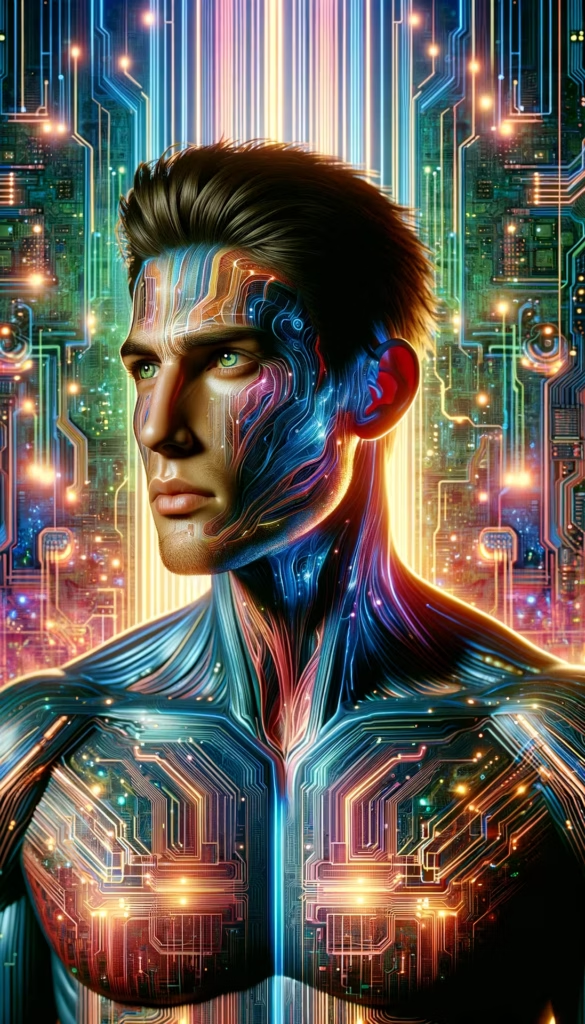
The Brain — The Body’s Onboard Computer
No machine operates without a controller. In advanced technology, computers are fed with data, process it and distribute commands through electrical circuits that results in outputs or actions. In the body, the brain performs a comparable integrative function. It receives sensory input, processes information in , and sends instructions through the nerves — pathways that act much like wiring. This results in either controlling voluntary movement (walking, writing) or automatic processes (for example breathing, heartbeat). In addition, the brain directs the body seamlessly, often without conscious awareness (body temperature while sleeping, etc) much like a computer where a program runs in the background.
The Heart — A Lifetime Hydraulic Pump
Machines that transport fluid rely on pumps, pressure, and pipelines. The human heart operates in the same manner, circulating blood through arteries and veins just as an engine circulates fuel through tubing. Same as fluid pressure is maintained in machines to prevent damage in pipes and components, blood pressure also is maintained to prevent body harm. The heart functions continuously for decades, far longer than most artificial pumps designed by engineering.
Bones & Muscles — Structural Frame + Mechanical Levers
A machine must be supported by a frame strong enough to contain its internal components and allow movement. The human skeletal system works alike; supporting shape, allowing motion, and protecting vital organs. Attached to this framework are the muscles, mimicking mechanical levers, engines and pulleys. When muscles contract and relax, they pull on bones to generate movement, much like robotic arms rely on cables and joints.
Lungs — Oxygen Filters and Gas Exchange System
Acts like engine air-intake filters. Air-dependent machines, particularly combustion engines, like we daily see in cars depend on oxygen input and gas exchange. A car has got an air-intake filter and exhaust system. Lungs operate comparably, pulling in oxygen while removing carbon dioxide — the body’s exhaust gas. The respiratory system filters, regulates, and distributes air without pause, ensuring that the bloodstream remains oxygenated, just as ventilation systems ensure continuous airflow in enclosed or high-functioning machinery.
Digestive System — The Body’s Natural Fuel Converter
Engines burn fuel, power plants convert coal or water to electricity, and batteries store energy chemically. At the end, it it based in an input – output process where something is fed, process, and an outcome is obtained where waste is normally inevitable . The body consumes food and breaks it down into usable energy, converting nutrients into glucose, fats, proteins, and vitamins that power biological activity. Inevitable, there is a remaining waste that is filtered and expelled efficiently, mimicking a machine exhaust system that disposes of by-products after energy extraction.
Self-Repair and System Maintenance
Perhaps the most impressive machine-like quality of the human body is its ability to repair itself. Machines usually works really well with self-diagnosis but usually require external mechanics, or human help to get repaired. On contrast with machines, the human contains its own built-in maintenance systems. Cuts heal, bones regenerate, cells replicate, and old parts are replaced automatically. The drawback when comparing with machines is that diagnosis is more complex and many health problem are actually overlooked by the body, only discovered by carrying medical test and screening.
Conclusion
While the human body is not made of metal, wires, or artificial circuits, its design logic, functionality, and efficiency directly resemble engineered machines. It processes data, pumps fluids, converts energy, exchanges gases, supports mobility through a framework, and even repairs internal damage autonomously.
The body may not look like a machine, but it undoubtedly works like one — and a remarkably superior one at that. In essence, the human body is not just a biological organism; it is nature’s most extraordinary machine, engineered not by humans, but by evolution itself.